Stop before you deposit. Run these six checks first, and you’ll know within five minutes whether a casino is safe or one you should walk away from entirely.
- Licence: Find the licence number in the footer and verify it on the regulator’s public register.
- Licence history: Check what the operator held before its current licence. A move down the ladder — Malta to Curaçao to Anjouan — matters more than the badge on show today.
- Blocking lists: In Norway, check the operator against Lotteritilsynet’s DNS blocking list. A blocked domain is a regulator’s judgement, not an opinion.
- Payment methods: Cross-check supported deposit and withdrawal options against the country-specific payment matrix for Canada, Ireland, or Norway.
- T&C withdrawal clauses: Scan for confiscation language, unlimited wagering requirements, or clauses that let the casino void winnings at will.
- Player complaints: Search the site name on Newcasino’s Casino Blacklist 2026 and check for a pattern of unresolved withdrawal complaints.
If any check fails, don’t deposit. If you have already lost money, the reporting route depends on where you live — the table further down lists the right body for Canada, Ireland and Norway.
Pro Tip: The licence check alone catches the majority of unsafe sites. Do it first, and if the number doesn’t appear on the regulator’s register, stop there.
Table of Contents
- What “blacklisted” means in this guide
- Casino player blacklist: can a casino blacklist you?
- Self-exclusion vs operator bans
- How to check if you are banned
- How to run a casino blacklist check in 6 steps
- Where to check: regulators and reporting channels
- Red flags that reliably predict an unsafe casino
- How to verify a casino licence in 3 minutes
- What to do if you find a blacklisted or suspicious casino
- How long do these checks take, and do they cost anything?
- How Newcasino builds the blacklist — and what it does not claim
- Key Takeaways
- The part of casino verification most players skip
- Useful sources and where to go next
What “blacklisted” means in this guide
A blacklisted casino, as Newcasino uses the term, is an operator flagged for one or more of these: a missing or fabricated licence, repeated failure to pay out winnings, manipulated game outcomes, or other clear scam indicators.
Regulatory blocking orders and editorial blacklists are two different things, and it is worth keeping them apart. A government block means a regulator has restricted access to a domain, usually over licensing or jurisdiction. Norway is the clearest example: Lotteritilsynet publishes a DNS blocking list, and Newcasino maintains a searchable copy of the blocked-domain list because the official version is a raw CSV. An editorial blacklist, like the one Newcasino maintains, is built from documented evidence of player harm and cited sources.
Most of this guide covers checks you run on a casino. The reverse question — whether a casino can blacklist you, and how that differs from self-exclusion — has its own sections further down.
Signs that always justify skipping a deposit:
- No licence number anywhere on the site
- Licence number that returns no results on the regulator’s register
- Withdrawal terms that allow the casino to confiscate winnings without explanation
- Zero verifiable payout history from real players
Pro Tip: If a casino’s “About” page has no company name, registered address, or ownership information, treat it as unverified and move on.
Casino player blacklist: can a casino blacklist you?
Yes. The checks above run in one direction — you vetting the casino — but the door swings both ways. Casino terms almost always reserve the right to close or restrict an account, and operators use it: suspected bonus abuse, multi-accounting, chargebacks, failed verification, or simply “at our discretion”.
The part most players miss is that a ban rarely stops at one brand. Many casinos are one company wearing several skins, and restrictions travel across the family: if an account is closed or limited at one brand, opening one at a sibling frequently fails, and some operators treat the attempt as circumvention. Our casino operator families map records who runs what — one Malta licence covers ArcticBet, BetSolid and NordicAutomaten, for example, so a ban at one of those is effectively a ban at all three.
There is no public register of banned players you can look yourself up in. What exists is each operator’s own records, applied across the brands that operator runs.
Self-exclusion vs operator bans
These get conflated constantly, and the difference decides what you can do about it. An operator ban is the casino’s decision, taken under its own terms; you cannot lift it, and you will not always get a reason beyond a clause number. Self-exclusion is your decision: a voluntary lock you place on yourself, typically running from six months to permanent and usually irreversible once set. The operator is obliged to keep you out, not choosing to.
What self-exclusion covers depends on where you live, and for the offshore sites this guide deals with, the honest answer is: less than you would hope.
- Ireland: GamStop covers operators licensed by the UK Gambling Commission, and residents of the Republic of Ireland cannot register for it in the first place — it does not reach the international casinos serving Irish players. Ireland’s own register, the NGEI, is established under the Gambling Regulation Act 2024 but was still rolling out at the time of writing. Until it covers the sites you actually use, protection is per-site — our GamStop in Ireland guide covers the gap in detail.
- Norway: Norsk Tipping’s Spillepause locks you out of Norsk Tipping’s own games only, and Norsk Rikstoto runs a separate exclusion you set with Rikstoto directly. Neither touches offshore casinos.
- Canada: Ontario’s regulated market requires licensed operators to provide cooling-off and self-exclusion tools. International sites serving the rest of Canada sit outside them, so protection there is per-site.
One more family caveat: unless the operator applies it group-wide, self-excluding at one brand can leave its sister brands open. Ask the operator directly which brands your exclusion covers, and get the answer in writing. The cooling-off period guide has the country-by-country detail.
How to check if you are banned
There is no register to search, so the check is practical:
- Try logging in. A closed account usually returns an explicit “account closed” or “account restricted” message rather than a wrong-password error. A password reset that succeeds, followed by a login that still fails, points the same way.
- Ask support in writing. Email rather than live chat, and ask directly: is the account closed, and under which clause of the terms? Keep the reply. You will not always get a reason, but a written refusal is evidence if you later dispute a withheld balance.
- Map the family before trying elsewhere. Find the operating company name in the terms — usually the first or last clause — and check it against the operator families page. Registering at a sister brand of a casino that banned you frequently fails, and some operators treat it as circumvention, which can put any winnings at risk.
- If you self-excluded and got back in anyway, that is the operator’s failure, not a loophole. Write to support, identify yourself as a self-excluder, and request account closure and the return of deposits made after your exclusion date.
How to run a casino blacklist check in 6 steps
This takes under five minutes for a site that passes. A site that fails usually reveals itself in step one.
- Check the licence number. Find it in the footer or the “About/Legal” section. Every legitimate operator lists it. Copy the exact number.
- Verify on the regulator’s register. Go directly to the regulator’s website by typing the URL manually. Search by licence number or operator name. Confirm the status reads “active” and the authorised activities include online casino gaming.
- Check the licence history, not just the current one. This is the step most guides skip. An operator that has moved from the Malta Gaming Authority to Curaçao to Anjouan is telling you something about which supervision it can still pass. Affiliate managers volunteer the current rung and rarely the ladder.
- Check the payment methods. Confirm the site supports standard deposit and withdrawal options for your country. A site that accepts deposits only in cryptocurrency, with no card or bank transfer option, is a significant warning sign.
- Read the withdrawal T&Cs. Search the terms for “void”, “forfeit”, “confiscate” and “at our discretion”. One clause that lets the casino cancel a withdrawal without cause is enough to walk away.
- Search the blacklist and player reviews. Run the casino name through Newcasino’s documented blacklist and look for a pattern of unresolved complaints, not just one or two unhappy players.
Pro Tip: Step 2 is the fastest filter. If the licence number returns nothing on the regulator’s site, every other check becomes irrelevant.
Where to check: regulators and reporting channels
Which register you search depends on where the operator is licensed. Which body you report to depends on where you are.
| Country | Regulator / register | Where to report a problem |
|---|---|---|
| Canada (Ontario) | iGaming Ontario directory and AGCO | Canadian Anti-Fraud Centre |
| Ireland | Gambling Regulatory Authority of Ireland | CCPC |
| Norway | Lotteritilsynet (and its DNS blocking list) | Forbrukerrådet |
| Offshore licences | Malta Gaming Authority, UK Gambling Commission, Curaçao Gaming Control Board | The issuing regulator’s own complaints process |
A note on the offshore row: an MGA or UKGC licence carries real supervision and a real complaints path. A Curaçao licence carries less, and licences from newer jurisdictions such as Anjouan carry less again. None of these are the same as being legal for you to use where you live, which is a separate question.
Newcasino’s resources for cross-checking:
- Casino Blacklist 2026: 57 documented sites with cited evidence
- Norway blocked-casino list: Lotteritilsynet’s DNS blocks, made searchable
- Casino licence comparison: what each jurisdiction actually requires
- Payment methods by country: country-specific payment verification
Pro Tip: Player-complaint aggregators like AskGamblers are useful for spotting patterns, but cross-check any complaint pattern against the regulator’s register before drawing conclusions.
Red flags that reliably predict an unsafe casino
These aren’t edge cases; they appear on nearly every confirmed fraudulent site.
- No verifiable licence, or a licence number that fails on the regulator’s register
- A licence history that steps down through progressively weaker jurisdictions
- Copied site design with generic stock imagery and no named ownership
- Cryptocurrency-only payments with no standard banking options
- Bonus offers wildly above market norms (500% match bonuses, “guaranteed” returns)
- Domain registered within the past six months
- Aggressive pop-ups and countdown timers pushing you to deposit immediately
- A pattern of unresolved withdrawal complaints across multiple review platforms
AskGamblers’ blacklist documents hundreds of operators flagged for nonpayment and withheld winnings, with the most common reason being systematic refusal to process legitimate withdrawals.
Blacklisted casinos are typically identified after repeated confirmed violations, not isolated complaints. One bad review doesn’t make a blacklist. A pattern of documented nonpayment, combined with a licence that doesn’t check out, does.
How to verify a casino licence in 3 minutes
Step 1: Open the casino site and scroll to the footer. Look for a licence number, the name of the issuing authority, and a company registration number. Legitimate operators display all three.
Step 2: Open a new browser tab and type the regulator’s URL directly. Do not click the badge on the casino’s site; those images can be faked, and a fake badge is one of the cheapest things to add to a website.
Step 3: Search the register by licence number or operator name. Confirm four things: the licence status is “active”, the company name matches what’s on the casino site, the authorised activities include online casino gaming, and the licence hasn’t expired.
Pro Tip: If the regulator’s register shows “suspended” or “revoked” next to the operator’s name, that’s a government-level warning, not just an editorial one. Stop immediately.
A mismatched company name between the casino site and the regulator’s register is one of the most reliable indicators of a fraudulent licence claim. The operator name on the site and the registered entity on the licence must be the same, or the licence is not theirs.
What to do if you find a blacklisted or suspicious casino
Act quickly. The window for recovery narrows fast once funds have moved.
- Document everything. Screenshot the casino’s terms, your deposit confirmation, any withdrawal requests, and all communications with support. Save these with timestamps.
- Contact your bank or card issuer immediately. For card payments, ask about a chargeback; card scheme rules generally allow a claim within 120 days of the transaction, though your issuer’s own deadline is what counts. Crypto payments are typically irreversible, so prevention matters far more than recovery there.
- Escalate to the regulator if the site holds a licence. File a formal complaint with the issuing authority. If the licence is fake or absent, skip this step.
- Report it where you live. Canada: the Canadian Anti-Fraud Centre. Ireland: the CCPC. Norway: Forbrukerrådet. These bodies do not usually recover individual losses, but reports build the enforcement picture.
- Notify your bank’s fraud team separately from the chargeback request, so they can monitor for further charges.
When you file, include:
- The operator’s trading name, domain, and any licence number displayed on the site
- Dates and amounts of every deposit and withdrawal request
- Screenshots of the terms as they appeared when you deposited
- Full support correspondence, with timestamps
- Your payment method and the transaction references from your bank statement
After the fact:
- Close or freeze any accounts linked to the site
- Change passwords if you used the same credentials elsewhere
- Check your credit report for unusual activity if you shared financial documents
How long do these checks take, and do they cost anything?
Most of the verification process costs nothing except a few minutes.
| Check | Time estimate | Cost |
|---|---|---|
| Licence number lookup (footer) | Under 1 minute | Free |
| Regulator register search | 1–3 minutes | Free |
| Licence history check | 2–5 minutes | Free |
| T&C withdrawal clause scan | 2–5 minutes | Free |
| Support contact test | 5–10 minutes | Free |
| Blacklist and blocking-list search | 2–3 minutes | Free |
| Test withdrawal | Hours to days | Requires a small deposit |
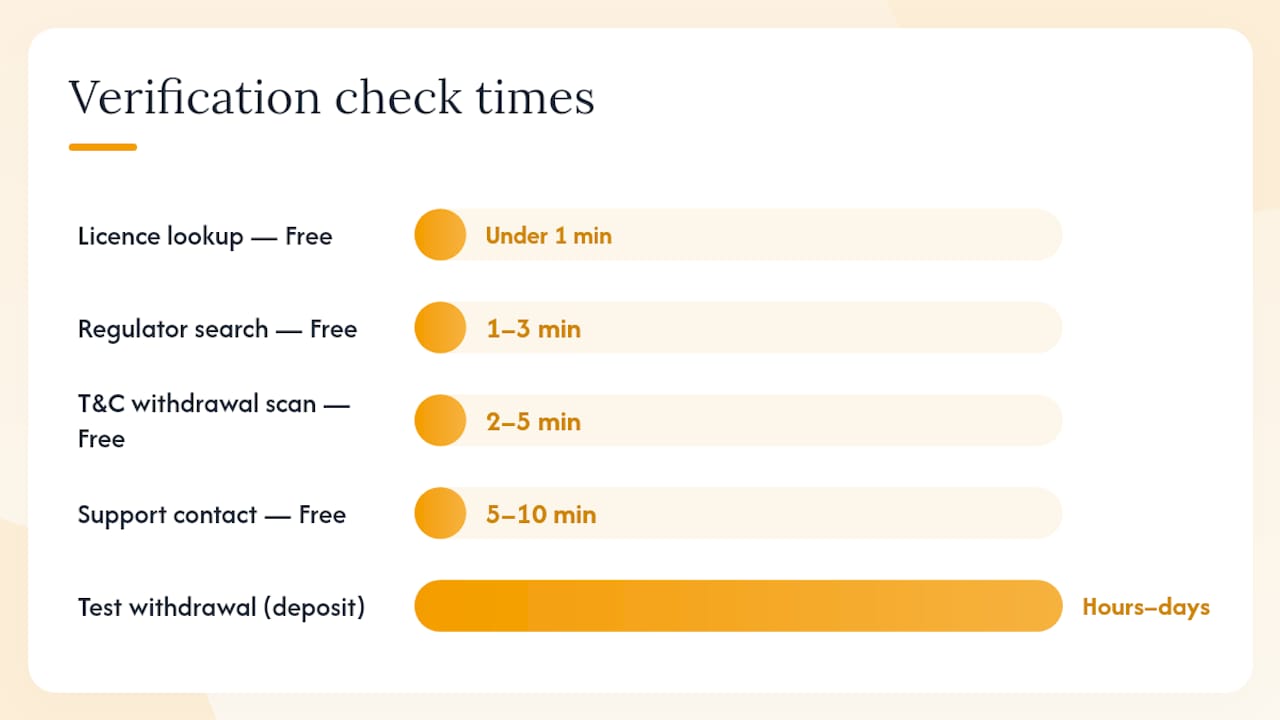
Every check except the last is free. The test withdrawal is the only one that needs money on the table, and it is optional — it earns its place when a site passes everything else but has little public payout history. It is wasted effort at a site that already failed the licence check.
Pro Tip: Skip paid “casino verification” services. Every check in this guide uses free public resources: regulator registers, national consumer bodies, and published blocking lists.
How Newcasino builds the blacklist — and what it does not claim
Newcasino’s Casino Blacklist 2026 lists 57 sites. Each entry cites the evidence behind it: a licence that fails on the issuing register, a documented pattern of unpaid withdrawals, a regulator’s blocking order, or terms that permit confiscation outright.
Worth being explicit about what that evidence is and is not, because plenty of review sites are vague here.
| Evidence type | What it shows |
|---|---|
| Licence check | Status on the issuing regulator’s register at the time of review, plus the licence history behind it |
| Regulator blocking order | A government decision, such as a Lotteritilsynet DNS block in Norway |
| Terms analysis | Confiscation clauses, wagering requirements, and dormancy or payout-threshold traps, quoted from the operator’s own T&Cs |
| Player complaint patterns | Repeated, independently reported nonpayment — patterns, not single reviews |
What is not behind those entries: our own deposit tests. Newcasino has run one first-hand editor deposit and withdrawal — MyStake, in 2026 — and it is logged openly in the Editor Test Log. Every other review on the site is built from cashier checks, licence records, terms analysis and player reports, and is labelled as such. An earlier version of that log overstated how many casinos had been tested first-hand; it was corrected, and this article is not going to quietly reintroduce the same claim.
That distinction matters when you are reading anyone’s blacklist, including this one. “We tested it” and “we documented it” are different claims, and a site that blurs them is asking you to trust something it has not shown you.
Key Takeaways
A missing or fake licence is present on every confirmed blacklisted casino, making the regulator register check the single most important step before any deposit.
| Point | Details |
|---|---|
| Licence check is non-negotiable | Verify the licence number directly on the regulator’s register before depositing anything. |
| Check the history, not just the badge | A ladder down through weaker jurisdictions is the pattern that predicts trouble. |
| Withdrawal T&Cs reveal intent | Confiscation clauses and vague “at our discretion” language predict payout problems before they happen. |
| Recovery is hard; prevention is easy | Card chargebacks may work, but crypto deposits are typically irreversible — verify first. |
| Blacklist vs. government block | An editorial blacklist documents player harm; a government block signals regulatory action. Both matter. |
The part of casino verification most players skip
The licence check gets all the attention, and it should. But the step that actually catches the most money lost isn’t the licence — it’s the withdrawal terms.
Players read the bonus percentage. Almost nobody reads the clause three paragraphs down that lets the casino void winnings “at management’s discretion”. That clause is legal cover for keeping your money, and it is sitting in plain text on more sites than most players realise. A licence tells you the operator is registered somewhere. The T&Cs tell you whether they intend to pay you.
The other underrated move: deposit small first. Put in the minimum, request it straight back out, and see what happens before you commit anything meaningful. It is the only check that produces actual behavioural evidence rather than a claim. A casino that delays a minimum withdrawal for two weeks without explanation has told you everything you need to know — and it has cost you nothing to find out.
Useful sources and where to go next
Regulators and reporting:
- Lotteritilsynet (Norwegian Gaming Authority)
- Gambling Regulatory Authority of Ireland
- Alcohol and Gaming Commission of Ontario
- Malta Gaming Authority licence verification
- UK Gambling Commission public register
- Canadian Anti-Fraud Centre
- AskGamblers blacklist (player complaint patterns)
Newcasino resources:
- Casino Blacklist 2026 — 57 Sites to Avoid
- Norway’s blocked-casino list, made searchable
- Casino licence comparison by jurisdiction
- Casino Payment Methods by Country 2026 Matrix
- Editor Test Log — what we have and have not tested
A note on third-party monitoring sites: Editorial blacklists from player-complaint platforms are useful for spotting patterns, but they are not legal enforcement tools. Cross-check any finding against the relevant regulator’s public register before drawing conclusions. An editorial flag without a corresponding licence problem is worth noting; an editorial flag combined with a failed licence check is a clear stop signal.
This article provides general information for player safety purposes. It is not legal or financial advice. Confirm current licensing status and regulatory requirements with the relevant authority or a qualified professional.