Slot volatility (also called variance) measures how a slot distributes its payouts across spins: low volatility means frequent, smaller wins; high volatility means rare but larger ones. Before you stake a single pound, knowing a game’s volatility tier is more useful than its RTP alone.
- Small bankroll? Choose low or medium volatility. Your money lasts longer and you’ll hit wins often enough to stay in the game.
- Chasing a big win? High-volatility titles carry the large multipliers, but budget for long dry spells between them.
- Size your bets accordingly. On high-volatility slots, drop your bet to 1–2% of your session bankroll so you have enough spins to reach a bonus round.
UK players can verify a casino’s licence on the Gambling Commission register and get safer-gambling support from BeGambleAware at any point.
Key takeaways
Volatility, not RTP, determines how your session bankroll behaves spin-to-spin, so check both figures before you play any slot.
| Point | Details |
|---|---|
| Volatility ≠ RTP | RTP is the long-run average return; volatility describes how wins are distributed across spins in a session. |
| Bet size to tier | On high-volatility slots, keep bets at 1–2% of session bankroll to survive long enough for bonus rounds to trigger. |
| Use demo mode | Play 200–500 free spins before staking real money on any high-volatility title to calibrate expectations. |
| Check the paytable | A max-win multiplier above 5,000x the bet is a reliable proxy for high or extreme volatility when no label is shown. Hit-frequency bands for these tiers are approximate; high-volatility games typically feature max wins above 5,000x and hit frequencies below 15%, while low-volatility titles will pair max wins below 1,000x with hit frequencies above 30%. |
| UK regulation gap | The UKGC requires RTP disclosure but does not mandate volatility labelling; use independent databases to fill the gap. |
Table of Contents
- What does slot volatility actually mean?
- How does volatility differ from RTP, and why do both matter?
- Volatility tiers: which level suits your play style?
- How volatility changes your session planning and bankroll
- How to check a slot’s volatility before you stake real money
- UK regulation, safer play, and where to get help
- How is slot volatility calculated mathematically?
- Common misconceptions about slot volatility
- Volatility should be your first filter, not an afterthought
- Sources
What does slot volatility actually mean?
Volatility describes how a slot’s return to player (RTP) is distributed across individual spins, not what the average payout is. Two slots can share a 96% RTP yet feel completely different in a 200-spin session, because one clusters small wins across most spins while the other concentrates value into rare, high-multiplier events, as observed in typical gameplay patterns.
Three mechanical factors drive that distribution:
Hit frequency is the percentage of spins that return any win at all. A low-volatility slot might pay on roughly 30–50% of spins; a high-volatility title can drop below 15%, according to volatility tier analysis from European Gaming. These are approximate hit-frequency bands—individual titles may vary, and some sources further subdivide volatility tiers beyond these broad ranges.
Payout distribution width describes how spread out the win sizes are. Low-volatility games cluster payouts tightly around small multiples of the bet. High-volatility games have a long right tail: most spins return nothing, but a small fraction return very large multiples.
Bonus trigger frequency and max-win multiplier compound the effect. When most of a slot’s value sits inside a bonus round that triggers once every 200+ spins, the base game feels barren regardless of the stated RTP. The max-win multiplier printed in the paytable is a quick proxy for how extreme that tail can be, as noted by CasinoBeats and Wild.
Pro Tip: Before loading a slot with real money, open the paytable and check two numbers: the RTP and the max-win multiplier. A max win above 5,000x the bet almost always signals high or extreme volatility, even when no label is shown.
How does volatility differ from RTP, and why do both matter?
These two metrics answer completely different questions.
- RTP answers: “Over millions of spins, what percentage of total wagers does this game return?” A 96.5% RTP means the game returns £96.50 for every £100 wagered across a very large number of spins, based on statistical expectations. It says nothing about how those returns are timed or sized within a single session.
- Volatility answers: “In my session tonight, how wild will the swings be?” It describes the shape of returns over the short run: how often you win, and how large those wins tend to be relative to your stake.
The practical consequence is that RTP is a long-run statistical mean and does not describe short-term pay frequency or variance. A slot with 96% RTP and low volatility might return you close to that figure after 500 spins, according to accumulated player experiences. A slot with the same 96% RTP but high volatility could leave you down 80% of your bankroll after 200 spins, then pay a 400x win on spin 201, as observed in typical session variance.
A concrete example. Imagine two toy slots, both with 96% RTP:
- Slot A pays 2x the bet on 48% of spins and nothing otherwise.
- Slot B pays nothing on 95% of spins and 40x the bet on the remaining 5%.
Both return 96 pence per £1 over time. But Slot A’s session standard deviation is tiny; Slot B’s is enormous. Volatility captures that difference; RTP does not.
Regulatory RTP disclosure often leads players to focus on RTP while overlooking volatility entirely. Independent review sites and the Newcasino RTP database help fill that gap by aggregating both figures so you can compare titles before choosing.
Volatility tiers: which level suits your play style?
The industry commonly uses a five-point scale, though most published descriptions collapse it into three main tiers with two intermediate grades. The table below maps each tier to its approximate hit-frequency range, typical max-win territory, and a named UK-familiar slot example.
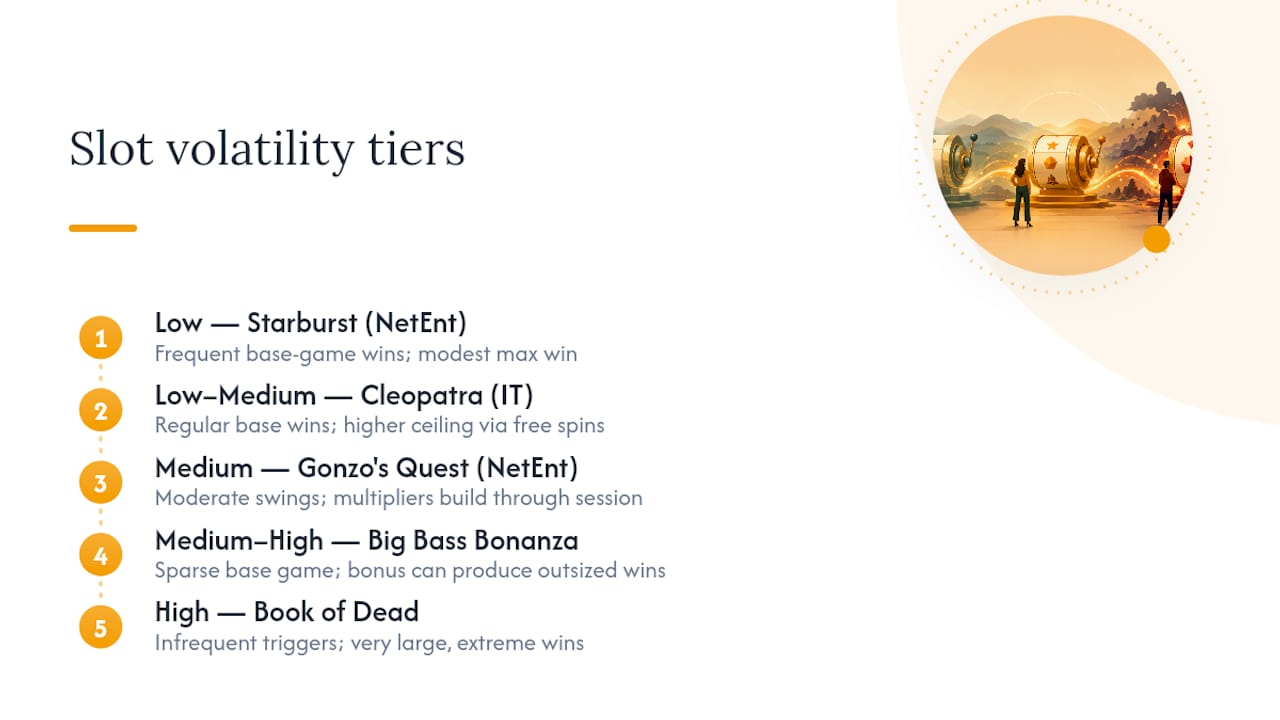
Hit-frequency bands are approximate heuristics drawn from iGaming Wheel’s tier analysis; individual titles vary.
Starburst (NetEnt) pays frequently in the base game via its expanding wilds mechanic, with a modest max win. It suits players who want steady action on a limited budget.

Cleopatra (IT) sits in the low-to-medium band: base-game wins come regularly, but the free-spins bonus with a 3x multiplier pushes the ceiling higher than pure low-volatility titles.
Gonzo’s Quest (NetEnt) sits squarely in the medium tier. Its Avalanche multipliers build through a session, creating moderate swings without the brutal dry spells of high-volatility play.
Big Bass Bonanza (Pragmatic Play) is medium-high: the base game is sparse, but the fishing bonus round can produce outsized wins. Most of the game’s value concentrates in that feature.
Book of Dead (Play’n GO) and Bonanza Megaways (Big Time Gaming) are both high-volatility titles. Book of Dead’s expanding symbol mechanic during free spins can produce very large wins but triggers infrequently. Bonanza’s Megaways engine and cascading wins create extreme variance, with a max win that can reach tens of thousands of times the bet.
A note on UK availability. Many UK casino lobbies do not display a volatility label alongside the game tile, as operators are not required to publish it. Check the developer’s own game page, an independent review, or the Newcasino RTP database to confirm before playing.
How volatility changes your session planning and bankroll
Volatility is the session-shaping metric. Two slots with identical RTP can produce radically different outcomes within a single evening, so treat volatility as your first filter when selecting a game, not an afterthought.
Bankroll heuristics by tier
- Low volatility: Bet up to 5% of your session bankroll per spin. Wins arrive often enough that you rarely need more than 50–100 spins to see a representative sample of the game.
- Medium volatility: Keep bets at 2–3% of session bankroll. Budget for 100–200 spins to give bonus features a reasonable chance to trigger.
- High volatility: Drop to 1–2% of session bankroll per spin. You may need 200–500 spins before a bonus round fires; undersizing your spin count is the most common mistake on these titles.
Session planning
- Set a hard loss limit before you start, not mid-session when emotions run high.
- If you’ve burned through 50% of your session bankroll without a bonus trigger on a high-volatility slot, consider reducing your stake rather than chasing the feature at the same bet size.
- Dry spells of 100+ spins without a significant win are statistically normal on high-volatility titles. They are not a sign the game is “due” to pay.
- Use the Newcasino wagering calculator to model how bonus wagering requirements interact with your bankroll before accepting a promotion tied to high-volatility slots.
The £20 method and its limits
The “£20 method” refers to testing a high-volatility slot with a fixed £20 budget at a low stake (e.g., 20p per spin, giving 100 spins) to gauge whether the game is paying before committing more. It’s a reasonable way to sample a title’s behaviour without heavy exposure. Its limitation: 100 spins is a small sample on a high-volatility game. You may exhaust the £20 without a bonus trigger simply because the hit frequency is genuinely low, not because the session is unusually cold. Use it as a budget cap, not as a reliable indicator of the game’s long-run behaviour.
Pro Tip: On any high-volatility slot, play 200–500 spins in demo mode before staking real money. Note how often the bonus triggers and what the average base-game win looks like. That data won’t predict your next session, but it calibrates your expectations and helps you size your real-money stake sensibly.
Volatility knowledge is not a substitute for a safety plan. Set deposit and loss limits via your casino’s responsible-gambling tools, and contact BeGambleAware if gambling stops feeling like entertainment.
How to check a slot’s volatility before you stake real money
Many studios do not publish a volatility label in the game itself. Use this checklist on any slot page before depositing.
- Check the in-game info panel. Open the paytable or “?” menu. Some developers (Pragmatic Play, Play’n GO) include a volatility indicator, often shown as a coloured bar or dot scale. If it’s there, use it.
- Read the max-win multiplier. A max win below 1,000x the bet usually signals low or medium volatility. Above 5,000x points to high or extreme. This is one of the most reliable proxies when no label exists, as highlighted by CasinoBeats.
- Scan the paytable structure. If the top symbol pays 500x or less and there are no free-spin or bonus multipliers, the game is likely low-to-medium volatility. If the paytable is sparse in the base game but describes a complex bonus with large multipliers, expect high volatility.
- Check published hit frequency. A handful of developers publish this figure. Below 15% is high volatility territory; above 30% is low.
- Run a demo test. Play 200–500 spins in free-play mode. Count how many spins return any win (hit frequency estimate) and note the largest base-game payout. This gives a directional read, though it remains noisy at small sample sizes.
- Consult independent databases and reviews. The Newcasino RTP database aggregates RTP and volatility indicators across titles. Professional review sites cross-reference developer documentation and player reports to fill the disclosure gap that operators leave.
- Avoid misleading signals. A casino lobby advertising “high-paying slots” is a marketing claim, not a volatility disclosure. Huge max-win figures in promotional banners tell you the ceiling exists, not how often you’ll approach it.
UK regulation, safer play, and where to get help
What the UKGC requires and what it does not
The UK Gambling Commission requires licensed operators to make RTP information available to players as part of its transparency and fair-play standards. It does not mandate that operators or developers publish a volatility label. That gap means you can find the RTP of almost any UK-licensed slot, but volatility data often requires independent research.
Verify that any casino you use holds a current UKGC licence before depositing. Check the licence number directly on the Commission’s public register, not just the casino’s own footer claim.
UK responsible-gambling resources
- BeGambleAware: The primary UK safer-gambling charity. Offers a helpline, self-assessment tools, and self-exclusion guidance via GamStop. Use it if you’re concerned about your own play or someone else’s.
- Gambling Therapy: Provides free online counselling, a live chat support service, and a self-help programme. Particularly useful for players who want structured support rather than just information.
- GamStop: The UK’s national self-exclusion scheme. Registering blocks you from all UKGC-licensed online casinos simultaneously.
Pro Tip: Use demo mode not just to assess volatility, but as a habit before every new title. It costs nothing, and it removes the pressure of live-money decisions while you’re still learning a game’s rhythm. Set a session time limit in your casino account settings before you switch to real play.
High-volatility slots amplify both wins and losses. A session that goes wrong on a high-variance title can deplete a bankroll faster than on a low-volatility game with the same RTP. Build your stop limits around volatility tier, not just total deposit amount.
How is slot volatility calculated mathematically?
Volatility is, in formal terms, the variance (or its square root, the standard deviation) of a slot’s payout distribution around its RTP mean. Game mathematicians calculate it from three inputs: the probability of each winning outcome, the payout size for each outcome, and the probability of triggering bonus features that modify those payouts.
The core formula is the standard statistical variance:
Variance = Σ [ p(x) × (x − μ)² ]
Where p(x) is the probability of outcome x, x is the payout for that outcome (expressed as a multiple of the bet), and μ is the expected value (the RTP expressed as a decimal). Summing that expression across every possible outcome gives the variance; the square root gives the standard deviation per spin.
In practice, a slot’s maths sheet lists hundreds of symbol combinations, each with its own probability and payout. The bonus round adds another layer: the probability of triggering it, multiplied by the variance of outcomes within the bonus, is added to the base-game variance. Titles where most value sits in a high-multiplier bonus round carry a disproportionately large bonus-variance component, which is why their overall volatility is high even when the base game looks modest.
Players cannot access a studio’s maths sheet directly. But the max-win multiplier and paytable structure are visible proxies for the shape of that distribution. A slot with a 20,000x max win has a much wider payout distribution than one capped at 500x, even if both share the same RTP.
Session standard deviation scales with the square root of the number of spins. After 100 spins on a high-volatility slot, your actual return can deviate enormously from the RTP mean. After 10,000 spins, it converges. That mathematical reality is why short sessions on high-volatility titles carry the most risk.
Common misconceptions about slot volatility
“High volatility means better odds.” It does not. Volatility and RTP are independent. A high-volatility slot can carry a lower RTP than a low-volatility one. The iGaming Wheel analysis is clear on this: volatility describes the shape of returns, not their long-run average. Check both figures separately.
“The slot is due a win after a long dry spell.” Each spin on a certified RNG slot is statistically independent. A run of 200 losing spins does not increase the probability of the next spin paying. This is the gambler’s fallacy, and high-volatility slots are particularly prone to triggering it because dry spells are genuinely long.
“A casino advertising ‘high RTP slots’ is telling you about volatility.” RTP disclosure is a regulatory requirement; volatility labelling is not. A lobby full of 97% RTP games could contain titles ranging from low to extreme volatility. The two metrics answer different questions.
“Demo mode volatility matches real-money volatility.” It should, and for UKGC-licensed games it generally does, because the same certified RNG governs both modes. However, some unlicensed or grey-market operators have been found to alter payout behaviour between demo and real-money play. Stick to UKGC-licensed casinos and cross-reference volatility data from independent sources. The Newcasino casino blacklist documents operators with documented integrity concerns.
“Volatility labels from the developer are standardised.” They are not. One studio’s “medium” may be another’s “medium-high.” There is no industry-wide agreed scale, which is why independent databases and review sites that normalise across studios are more reliable than in-lobby labels alone.
Volatility should be your first filter, not an afterthought
Most players open a casino lobby, spot a familiar title or a big jackpot figure, and click play. RTP gets a glance; volatility rarely does. That ordering is backwards.
RTP tells you the long-run cost of playing. Volatility tells you what tonight’s session will actually feel like. If your budget is £30 and you load a high-volatility slot at £1 a spin, you have 30 spins to hit a bonus round that might trigger once every 150 spins on average. The maths are against you before you start, regardless of the RTP.
My recommendation: treat volatility as the first filter. Decide your session budget and your risk tolerance before you choose the game, not after. If you want a two-hour session on £40, a medium-volatility title at 20–40p per spin gives you the spin count to experience the game properly. If you’re specifically targeting a large win and you accept that you may lose the full budget without hitting it, a high-volatility title at a small stake is the appropriate choice.
The paytable check takes 60 seconds. The demo-mode test costs nothing. Running 200–500 free spins on a high-volatility title before staking real money is the single most underused tool available to UK players. Combine that with a verified casino from Newcasino’s independent casino reviews and a hard stop-loss limit set before you start, and you’ve done more than most players ever do to protect their session.
Volatility won’t make you win. But understanding it will stop you from making avoidable mistakes.
You need a library wide enough to actually choose volatility
Picking a volatility band only works if the site carries enough studios to give you the choice. Vegadream lists 166+ providers including Nolimit City, Big Time Gaming and Thunderkick at the high-variance end, alongside Evolution live tables — and its wagering falls from 30x to 20x across the welcome package, which matters more on a high-volatility bankroll than the headline does.
18+ · T&Cs apply · Gamble responsibly · GamblingCare.ie · Hjelpelinjen 800 800 40
Sources
- Return to player
- Gambling Commission
- BeGambleAware
- Slot Volatility Explained | European Gaming
- What Is Slot Volatility? An In-Depth Guide to High Volatility Slots & Low Volatility Slots – CasinoBeats
- Slot Volatility Explained — Low, Medium, High, Extreme | iGaming Wheel
- Wild
- Gambling Therapy
Ready to apply what you’ve learned? Newcasino’s independent casino reviews cover licence status, RTP disclosures, and bonus terms so you can choose a verified operator before you play. Every review on the site is licence-checked against the UKGC public register. This is general information about slot mechanics, not financial or gambling advice. Confirm current game details and licence status directly with the operator or the UKGC register before depositing.